Key Takeaways
- The gas vs electric furnace decision depends on energy costs, climate, installation requirements, efficiency, maintenance, and the heating needs of your home.
- Gas furnaces typically produce strong heat quickly, which can be particularly valuable during cold Westchester County winters.
- Electric furnaces convert electricity directly into heat efficiently at the equipment level, but operating costs depend heavily on local electricity rates and heating demand.
- Gas furnaces require combustion, venting, and a suitable fuel connection, while electric furnaces generally have simpler installation requirements.
- Upfront installation cost should not be the only consideration. Homeowners should compare long-term energy use, maintenance, comfort, equipment lifespan, and existing home infrastructure.
- Professional furnace sizing and installation are critical regardless of which system you choose.
- Royal Comfort can evaluate your home’s current heating system and help determine which heating option best fits your comfort goals and budget.
Gas vs Electric Furnace: Which Is Better for Your Home?
When it is time to replace a heating system, homeowners often face an important question: should the next furnace run on natural gas or electricity?
The gas vs electric furnace comparison is not as simple as declaring one system better than the other. Both can provide reliable home heating, but they operate differently and come with different installation requirements, energy considerations, and comfort characteristics.
For homeowners in Westchester County, climate is especially important. Heating systems must perform reliably through long periods of cold weather, making both operating costs and heating performance important parts of the decision.
A gas furnace may make sense for a home that already has natural gas service and compatible venting. An electric furnace may appeal to homeowners looking for simpler equipment without combustion. However, energy prices, home efficiency, furnace size, and heating demand can significantly change the long-term economics.
Understanding the differences can help you make a more informed choice.
How Does a Gas Furnace Work?
A gas furnace burns natural gas to generate heat.
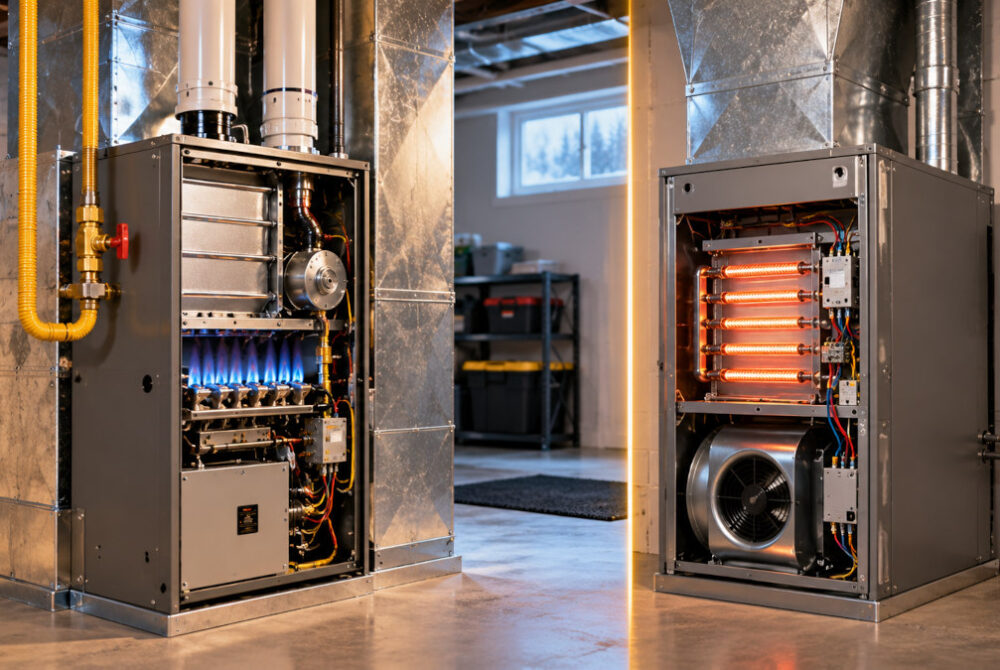
When the thermostat calls for heating, the furnace begins a controlled combustion process. Heat generated by the burners warms the heat exchanger, and the blower circulates air across the heat exchanger.
The heated air then travels through the home’s ductwork.
Major components can include:
- Gas valve
- Burners
- Ignition system
- Heat exchanger
- Blower motor
- Exhaust venting
- Control board
- Safety switches
- Thermostat
Because combustion takes place inside the furnace, proper installation and maintenance are particularly important.
Exhaust gases must be safely vented outside, while components involved in combustion must operate correctly.
How Does an Electric Furnace Work?
An electric furnace operates differently.
Instead of burning fuel, electricity passes through heating elements. These elements become hot, and the blower moves air across them before distributing the heated air throughout the home.
Electric furnaces do not require combustion.
As a result, they generally do not need the same gas connections or combustion exhaust systems associated with gas furnaces.
The basic process is relatively straightforward:
- The thermostat calls for heat.
- Electric heating elements activate.
- The blower moves air across the heating elements.
- Heated air travels through the ductwork.
- The furnace shuts off when the desired temperature is reached.
Although electric resistance heating converts electricity into heat very effectively at the point of use, that does not automatically mean it will be the least expensive system to operate.
Energy prices and the amount of heating required throughout winter are equally important.
Gas vs Electric Furnace: The Main Differences
Here is a simplified comparison.
| Factor | Gas Furnace | Electric Furnace |
|---|---|---|
| Energy source | Natural gas | Electricity |
| Combustion | Yes | No |
| Exhaust venting | Required | Generally not required for combustion |
| Heating response | Typically fast | Reliable, potentially slower depending on system |
| Equipment complexity | More combustion-related components | Relatively straightforward |
| Maintenance needs | Regular combustion and safety inspection important | Generally simpler |
| Operating cost | Depends on gas prices and efficiency | Depends heavily on electricity rates |
| Installation | May require gas and venting infrastructure | Requires sufficient electrical capacity |
| Best choice | Depends on home and local conditions | Depends on home and local conditions |
The right choice requires looking beyond one individual category.
Which Costs Less to Operate?
Operating cost is one of the biggest questions in the gas vs electric furnace debate.
Unfortunately, there is no universal answer because utility prices vary.
The amount you spend heating your home depends on:
- Local natural gas prices
- Electricity rates
- Furnace efficiency
- Home insulation
- Thermostat settings
- Outdoor temperature
- Furnace capacity
- Heating habits
- Air leakage
- Ductwork condition
In cold climates with substantial winter heating demand, the difference in energy prices can become particularly important.
Homeowners should therefore compare estimated annual operating costs rather than focusing only on the efficiency percentage printed on the equipment.
Understanding Furnace Efficiency
Gas furnace efficiency is commonly expressed as Annual Fuel Utilization Efficiency, or AFUE.
AFUE indicates how much of the fuel consumed by a furnace becomes usable heat over the course of a typical year.
For example, a higher AFUE indicates that less energy is being lost during the heating process.
Electric resistance furnaces operate differently because they do not lose energy through combustion exhaust.
However, comparing equipment efficiency alone can be misleading.
A highly efficient appliance using a relatively expensive energy source may still cost more to operate than another heating system using a less expensive source of energy.
The U.S. Department of Energy provides additional information about furnaces, boilers, efficiency, and heating system upgrades for homeowners comparing heating technologies.
Upfront Installation Costs
Operating cost is only half of the financial equation.
Homeowners also need to consider installation.
The cost of a furnace installation depends on:
- Equipment capacity
- Efficiency
- Furnace technology
- Existing ductwork
- Fuel connections
- Electrical service
- Venting
- Equipment location
- Installation complexity
A home that already has natural gas service, compatible venting, and a gas furnace may be relatively straightforward to upgrade with another gas system.
Converting a home from electric heat to gas can require additional work.
Likewise, installing an electric furnace may require electrical upgrades if the home’s existing service cannot support the new equipment.
If you’re beginning to budget for furnace replacement, our guide to the cost of new furnace and installation explains the major factors that influence the overall investment.
Which Furnace Provides Better Comfort?
Cost matters, but your heating system’s primary job is keeping your home comfortable.
Gas and electric furnaces can both provide reliable heating when properly sized and installed.
However, homeowners may notice differences in how that heat feels and how quickly the home reaches the desired temperature.
Gas Furnace Comfort
Gas furnaces are known for delivering strong heating output.
During particularly cold weather, this can help the home reach the thermostat setting relatively quickly.
Modern gas furnaces may also include:
- Two-stage heating
- Variable-speed blowers
- Advanced thermostat controls
- Zoning compatibility
These features can improve temperature consistency and reduce noticeable swings between heating cycles.
Electric Furnace Comfort
Electric furnaces can also maintain comfortable indoor temperatures when appropriately sized.
They may operate differently from gas equipment, and the air supplied through the registers may feel different depending on system design and operating conditions.
Ultimately, comfort depends heavily on proper sizing, airflow, duct design, insulation, and controls, not simply the energy source.
Gas Furnace Installation Considerations
If you’re considering gas equipment, several installation requirements need to be evaluated.
Gas Supply
The home must have an adequate natural gas connection capable of supporting the furnace.
Venting
Combustion gases must be safely exhausted outside.
High-efficiency furnaces may use different venting configurations than older equipment.
Condensate Drainage
Certain high-efficiency furnaces produce condensation that must be properly drained.
Ductwork
Existing ductwork must provide adequate airflow for the new equipment.
Controls
The thermostat must be compatible with the furnace’s operating stages and features.
For a more detailed look at the process, see our guide to gas furnace installation in Westchester County, NY.
Electric Furnace Installation Considerations
Electric furnaces avoid several combustion-related requirements, but installation still requires careful planning.
Important considerations include:
- Electrical panel capacity
- Circuit requirements
- Furnace capacity
- Ductwork
- Thermostat compatibility
- Equipment location
Electric resistance heating can require substantial electrical power.
A professional should verify that the home’s electrical infrastructure can safely support the equipment before installation begins.
Maintenance: Gas vs Electric Furnace
Both systems require maintenance, although the specific tasks differ.
Gas Furnace Maintenance
Professional gas furnace maintenance may involve:
- Burner inspection
- Ignition testing
- Heat exchanger inspection
- Gas pressure verification
- Combustion testing
- Venting inspection
- Blower inspection
- Electrical testing
- Safety control testing
Because a gas furnace involves combustion, safety-related inspections are particularly important.
Electric Furnace Maintenance
Electric furnace maintenance may include:
- Heating element inspection
- Electrical connection testing
- Blower inspection
- Airflow testing
- Thermostat testing
- Safety control inspection
Regardless of furnace type, filters also need regular attention.
Royal Comfort’s HVAC maintenance memberships provide preventative maintenance options designed to help homeowners keep heating and cooling equipment operating safely and efficiently throughout the year.
Reliability and Repair Considerations
Both furnace types can provide years of dependable heating when properly installed and maintained.
Gas furnaces contain combustion-related components that may eventually require service, including:
- Igniters
- Flame sensors
- Gas valves
- Inducer motors
- Heat exchangers
Electric furnaces have fewer combustion-related components but still rely on:
- Heating elements
- Relays
- Sequencers
- Blower motors
- Electrical controls
Rather than assuming one type will never require repairs, homeowners should consider equipment quality, installation quality, maintenance, and overall system design.
Safety Differences
Safety is another important factor when comparing gas vs electric furnace systems.
Gas Furnace Safety
Because natural gas is burned to generate heat, proper combustion and exhaust venting are essential.
Professional maintenance helps identify potential issues involving:
- Heat exchangers
- Burners
- Gas connections
- Exhaust venting
- Safety controls
Homes with fuel-burning appliances should also have properly installed and functioning carbon monoxide detectors.
Electric Furnace Safety
Electric furnaces do not produce combustion gases.
However, they operate using high electrical loads, making proper wiring, circuit protection, and installation equally important.
Neither system should be installed or extensively serviced without appropriate professional knowledge.
What About Heat Pumps?
Homeowners comparing gas and electric furnaces should also consider whether a heat pump belongs in the conversation.
A heat pump uses electricity differently from an electric resistance furnace. Rather than generating heat primarily through resistance elements, it transfers heat from one location to another.
Modern heat pumps can provide both heating and cooling, potentially allowing one system to handle year-round comfort.
The best solution depends on:
- Climate
- Home efficiency
- Existing equipment
- Utility costs
- Comfort preferences
- Installation requirements
For some homeowners, the real comparison may ultimately become gas furnace versus heat pump rather than gas furnace versus electric resistance furnace.
Which Furnace Is Better for Westchester County?
Westchester County experiences substantial heating demand during winter, so system selection should account for cold-weather performance and long-term energy consumption.
A Gas Furnace May Be Particularly Attractive When:
- Natural gas is already available.
- Existing gas infrastructure is in good condition.
- Strong cold-weather heating is a priority.
- The home already uses forced-air heating.
An Electric Furnace May Deserve Consideration When:
- Natural gas is unavailable.
- Avoiding combustion equipment is a priority.
- Installation conditions favor electric equipment.
- Electrical infrastructure can support the required load.
There is no universal winner.
The best system is the one that fits the home’s infrastructure, heating requirements, energy costs, budget, and long-term comfort goals.
Consider the Entire Home, Not Just the Furnace
Heating equipment does not operate independently from the rest of the house.
Even an efficient furnace may struggle in a home with:
- Poor insulation
- Significant air leakage
- Damaged ductwork
- Inadequate return airflow
- Old windows
- Poor thermostat placement
Before investing in higher-capacity equipment, it can be worthwhile to determine whether improvements elsewhere in the home could reduce heating demand.
Lower heating demand can improve comfort while helping the furnace operate more efficiently.
Why Homeowners Choose Royal Comfort
Choosing between gas and electric heating requires more than comparing equipment specifications online.
Royal Comfort provides heating and cooling services throughout Westchester County and can evaluate the entire HVAC system before recommending replacement equipment.
A professional evaluation can consider:
- Current furnace condition
- Home heating requirements
- Existing fuel source
- Electrical capacity
- Ductwork
- Venting
- Equipment efficiency
- Comfort concerns
- Budget
Royal Comfort provides:
- Furnace installation
- Furnace replacement
- Furnace repair
- Emergency heating service
- Preventative maintenance
- Heat pump installation
- Air conditioning services
- HVAC system evaluations
Rather than selecting a system based on a single feature, homeowners can compare the long-term advantages and limitations of each option.
Gas vs Electric Furnace: Making the Final Decision
The gas vs electric furnace decision should consider much more than the purchase price of the equipment.
A gas furnace may provide powerful cold-weather heating and attractive operating economics in homes that already have natural gas service.
An electric furnace eliminates combustion and can offer simpler equipment, but electricity costs and substantial winter heating demand must be carefully considered.
Before making a decision, compare:
- Installation cost
- Estimated annual energy consumption
- Local utility rates
- Furnace efficiency
- Maintenance requirements
- Existing home infrastructure
- Comfort preferences
- Long-term ownership costs
A professional evaluation can help put these factors into context for your specific home.
Find the Right Heating System for Your Home
If your current heating system is aging, unreliable, or increasingly expensive to operate, contact Royal Comfort to schedule a heating system evaluation. The Royal Comfort team can assess your existing equipment and help you compare gas, electric, and other heating options based on your home’s actual needs.
Frequently Asked Questions
Is a gas or electric furnace cheaper to operate?
Operating costs depend on local natural gas and electricity rates, furnace efficiency, home efficiency, thermostat settings, and heating demand. In a cold climate, energy prices can significantly affect the long-term difference.
Is an electric furnace more efficient than a gas furnace?
Electric resistance furnaces convert electricity into heat at the equipment level without combustion exhaust losses. However, equipment efficiency alone does not determine operating cost. The price of electricity and total heating demand must also be considered.
Does a gas furnace heat a home faster?
Gas furnaces often provide strong heating output and can raise indoor temperatures quickly. Actual performance depends on furnace capacity, system design, airflow, and the home’s heating requirements.
Does an electric furnace require venting?
Electric resistance furnaces do not burn fuel, so they generally do not require combustion exhaust venting. They do, however, require appropriate electrical service and professional installation.